
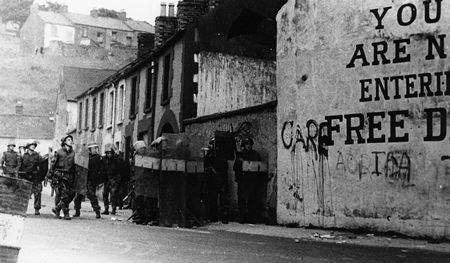
This House Believes Internment was a Necessary Evil

internment

The 17th Ordinary Meeting of the 165th session of the Literific took place on the 6th of March in the Senate Room. Our guest chair for the evening, Professor John Brewer, had a few opening remarks.

Ryan Jones and Andrew Carruthers proposed the motion. Jones argued that internment is a legitimate tool of war and that the only more effective alternative is extermination. He said it may have been evil but there was no other way to deal with insurgency. Carruthers said that interment showed the people the immorality of Britain and that this forced them to make their voices heard. t forced the people to demand more.

Katy Waller and Harry Adair took centre stage to staunchly oppose internment. Waller told the House that internment took away the rights of stability and movement. Instead of protecting the people, it encourages them to see the state as something to be feared. She said that something that takes rights away should never be seen as necessary. Adair then closed the debate. He said internment was detrimental to community relationships.  The alternative to internment, he argued, was to not put innocent people behind bars.

Professor Brewer then summarised and commented on the speeches. Closing statements were heard and the House then went to a vote. The motion was defeated.

This House Would Make a Musical

musical


The 16th Ordinary Meeting of the 165th Session of the Literific took place on the 27th of February in the Senate Room. Ciarán Gallagher ended a riff off by starting Bohemian Rhapsody which then turned into a group singing thing with piano played by Henry Adams.

Ciarán Gallagherand Paul Shannon were the proposition. Ciaran had a speech but was interrupted by bagpipes and the arrival of our favourite German Sebastian Eckert. His actual argument was quite good and serious and focused on the uniqueness of musicals and how they consist of wonderful things. Shannon then continued for the proposition. He commented on the shambolic nature of the evening before moving on to his three reasons for supporting the motion, his reasons three. There was singing, logic and observations of the Literific council.

Ben Murphy and Jonny Finlay opposed musicals! Murphy felt musicals contained an unnerving amount of optimism and that they do not reflect life as it is since life can be kind of terrible. Finlay begged us not to waste membership money on a musical that would just end up as gifs on Tumblr. Instead he recommended creating a blockbuster movie, suggested titles being Adam Potter and the Standing Order of the Phoenix or Doctor Whom. Both titles were accompanied by detailed descriptions.

The debate then went to the floor. We then went to a vote and the motion passed.

This House Would Raise Gender Neutral Children

The 14th Ordinary Meeting of the 165th Session of the Literific took place on the 13th of February in the Senate Room. It was co-hosted by QUB LGBT+

Ellen Murray and Fionn Rodgers took the proposition. Murray argued that gender is such a big part of our lives that separates us into boxes from the day we are born. These boxes can later affect what people do with their lives with society not accepting gender imbalances. If children were raised as gender neutral then they would learn to not discriminate between each other. Rodgers argued that it shouldn’t be up to the parent to force a preconceived idea of gender onto a vulnerable child that is open to learning whatever it is told. By raising children as gender neutral you’d be giving them the right to do what they want.

Charlie Barnes and Brendan Kelters opposed the motion. Barnes argued that it is the gender binary that is the problem and that gender is not, and should not, be a social construct. Instead of raising children as gender neutral he suggested we get parents to realise that there is a spectrum when it comes to gender. Kelters closed the debate. He suggested that gender neutrality is in itself a distinct gender and that the gender binary is rudimentary psychology that shouldn’t be something where you are classified as one or the other. By raising children as gender neutral, it could lead to confusion about how they interpret themselves.

The debate then went to the floor. Both sides summarised and the motion went to a vote. The motion was defeated.